
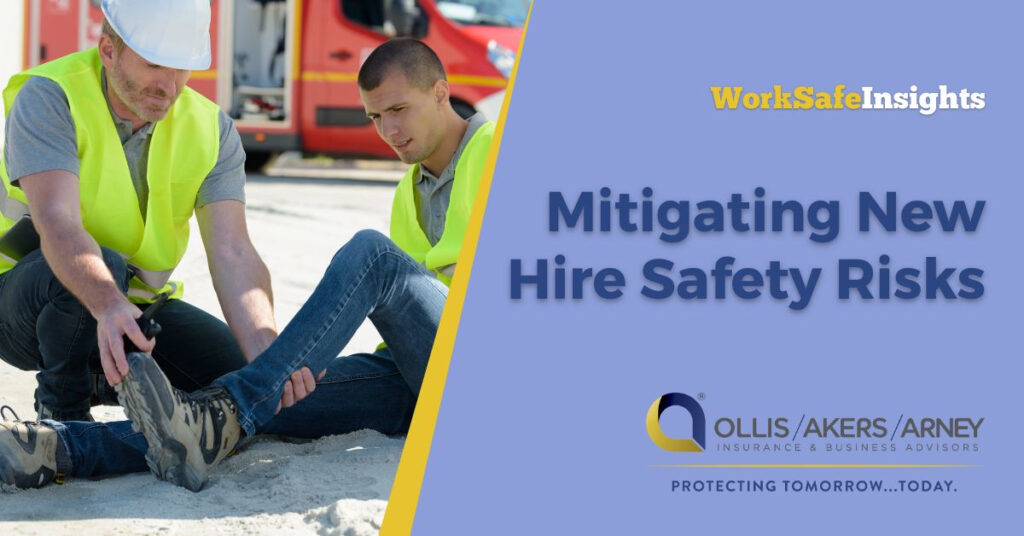
While hiring new staff can help employers expand their talent pools and deepen their workforce, it also carries additional safety risks. Multiple studies show that employees are up to six times more likely to experience a workplace injury in their first 30 days on the job, with 1 in 8 injuries occurring on the first day. These injuries largely stem from both training and cultural gaps.
Failure to address new hire safety risks can lead to serious accidents, increased workers’ compensation costs, diminished productivity levels and poor staff morale. With this in mind, employers can’t afford to ignore the potential dangers associated with hiring new staff. This article outlines common new hire safety risks and offers top strategies to help mitigate related workplace accidents and injuries.
Common New Hire Safety Risks
While new hire safety risks may vary based on business size, industry and location, some of the most common include:
Slips, trips and falls. Although slips, trips and falls are the leading cause of injuries for employees across industry lines, new hires are especially at risk due to their limited knowledge of workplace layouts and high-risk areas (e.g., wet or cluttered floors, unstable walking surfaces and changes in elevation).
Overexertion and musculoskeletal injuries. These injuries often stem from improper lifting techniques, poor ergonomics or repetitive motions. New hires may be more likely to experience overexertion and musculoskeletal injuries in an effort to prove their capabilities and avoid asking for help, even when they are pushing themselves too hard.
Struck-by incidents. Such incidents usually occur due to collisions with moving vehicles, equipment or fallen materials. They can lead to serious injuries, including concussions and broken bones. New hires may be increasingly prone to these incidents due to a lack of situational awareness and hazard recognition.
Caught-in or -between hazards. These hazards generally involve getting one or more body parts caught in machinery or otherwise compressed between two objects. They can cause severe bodily trauma and, in some cases, death. New hires may be more susceptible to these hazards due to their limited training on safe equipment operation and associated lockout/tagout (LOTO) procedures.
Exposure to harmful substances. Based on the nature of their work, employees may be exposed to various harmful substances (e.g., chemicals and cleaning agents) on the job. Inhaling, ingesting or otherwise coming in contact with these substances can cause lasting skin burns and respiratory issues. New hires are particularly at risk of such exposure due to their limited familiarity with personal protective equipment (PPE) and chemical-handling safety measures.
Mitigation Strategies
Fortunately, there are several strategies employers can implement to help reduce new hire safety risks and promote an injury-free workplace. Consider these best practices:
Create structured onboarding programs. Employers should develop in-depth onboarding programs that emphasize company culture, norms and safety expectations. These programs should follow a staged learning approach, breaking down each element of workplace safety training into manageable phases. In doing so, employers can bolster employee engagement and protect new hires from being overwhelmed by receiving too much information at once.
Provide detailed safety documentation and signage. Alongside structured onboarding programs, employers can use written materials to keep safety top of mind among new hires. Namely, employers should develop comprehensive safety manuals that highlight common occupational hazards and prevention measures, as well as individual policies outlining specific safety procedures. Key topics to address in this documentation include workplace layouts and traffic routes, housekeeping protocols, ergonomic guidelines, PPE requirements, machine guarding, safe equipment operation and LOTO standards, chemical labeling and storage systems, and pacing and workload expectations. Safety signage should also be posted throughout the workplace to alert staff to nearby hazards, such as high-risk areas or unstable walking surfaces.
Ensure ample supervision. New hires should receive additional supervision and support during their first few months on the job to confirm they can correctly identify and respond to workplace hazards. Employers should ensure that new staff are consistently monitored by management, especially when working in high-risk areas or performing dangerous tasks. Additionally, employers should consider implementing a buddy system, in which new hires are mentored by more experienced employees.
Conduct frequent check-ins. In addition to extra supervision and support, employers should schedule more frequent check-ins with employees as they begin their new roles. These individual meetings should be led by a supervisor or safety representative, giving new hires an opportunity to ask any ongoing questions about workplace safety measures or to request further assistance with managing their workloads. Hosting these periodic check-ins can empower employees to speak up when they are struggling and remove any stigma associated with asking for help.
Offer reinforcement training. Safety training shouldn’t be a one-time event. Even after onboarding is complete, new hires should be required to attend periodic reinforcement training on essential safety topics. Such training can help employees refresh their knowledge of existing workplace safety measures and learn about new or emerging hazards.
Encourage hazard reporting. New hires should receive clear instructions on how to report near-misses, as well as voice concerns about current safety precautions and call out any unaddressed hazards. This can help employers maintain an open dialogue surrounding workplace safety, encouraging employees to play their part in protecting both themselves and their co-workers from injuries.
Conclusion
New hire safety risks can pose serious challenges, but they are often manageable with the right systems in place. By combining thorough onboarding, heightened safety awareness and consistent supervision, employers can significantly reduce the likelihood of new hire accidents and injuries. A strong safety culture must be communicated from the first day on the job, not as a checklist item, but as a core value. Encouraging new employees to ask questions, report any unaddressed hazards and speak up without fear of judgment or punishment builds the psychological stability needed for proper safety vigilance. When employers invest in new hire safety, they can help foster a long-term commitment to protecting their workforce and ensure successful operations for years to come. Contact us today for additional workplace safety resources.
This WorkSafe Insights is not intended to be exhaustive safety guidance nor should it be construed as legal advice. Readers should contact legal counsel or an insurance professional for appropriate advice. © 2026 Zywave, Inc. All rights reserved.