
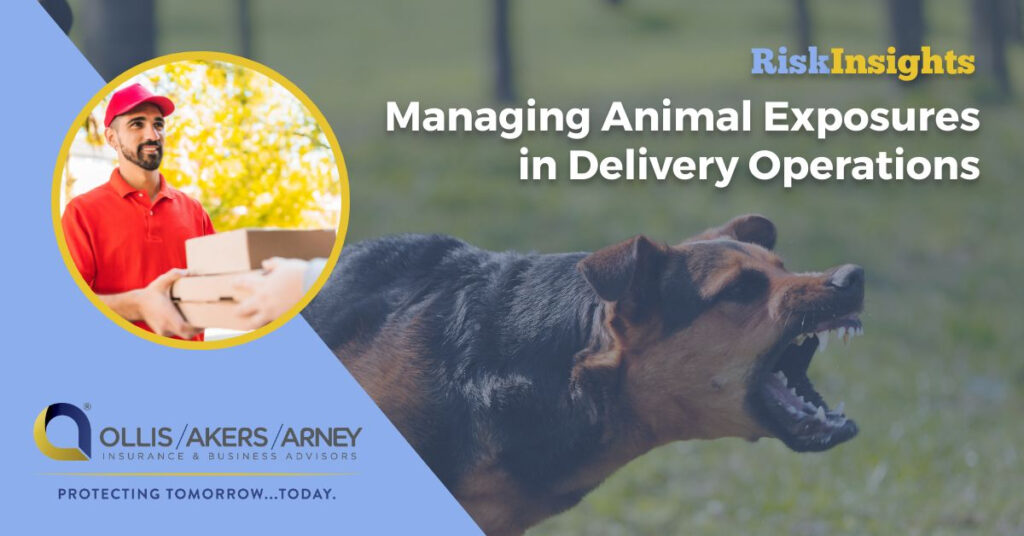
Businesses across several sectors may utilize delivery operations to better serve their customers, including retailers, restaurants, grocers, health care providers, manufacturers and artisans. While these operations can certainly prove beneficial by enhancing customer convenience and ensuring timely services, they also pose unique risks. In particular, delivery drivers may encounter multiple exposures along their routes, resulting in serious incidents and disruptions. One of the most prevalent exposures is contact with potentially dangerous animals—both domestic and wild.
Animal encounters can occur in commercial, residential and rural settings, putting delivery drivers at risk in virtually any environment. When these incidents occur, particularly when they leave drivers with severe injuries or trauma, they can carry considerable consequences for impacted businesses, including poor staff morale, operational delays, financial losses and lasting reputational damage. With this in mind, it’s crucial for businesses that conduct deliveries to take steps to limit animal exposures, thereby protecting their employees and operations. This article provides more information on the key risks and ramifications of animal exposures in delivery operations and offers related mitigation strategies.
Key Risks and Ramifications
Animal exposures during delivery operations primarily stem from unrestrained and territorial pets (e.g., cats and dogs), poorly secured livestock in rural areas, and wildlife encounters. These animals may physically intimidate delivery drivers by growling, barking or chasing them. Potentially violent animals may also cause serious harm by biting, scratching, kicking or trampling delivery drivers. While animal encounters can occur at any time, they are more common in certain situations, such as when delivery drivers must walk through or across customers’ yards, approach front doors or main property entrances, or make deliveries at night or in other low-visibility conditions. Some environmental factors may also play a role in these incidents, including adverse weather, seasonal animal behaviors (e.g., migration, foraging and reproduction), and attraction to food-containing packages or other goods with a strong scent. Delivery drivers who lack proper training or knowledge of company policies regarding animal encounters, as well as those who fail to recognize these hazards due to workload pressures or job complacency, may also be more susceptible to such incidents.
In any case, animal exposures during delivery operations can carry various ramifications for impacted businesses, including:
Employee safety and well-being concerns — Physical incidents with animals can severely injure delivery drivers, potentially resulting in lacerations, broken bones and other bodily trauma. Depending on the extent of these injuries, they could cause permanent disabilities or disfigurement. Animal bites could also transmit harmful infections and diseases, such as rabies or tetanus. Even if delivery drivers don’t come into direct contact with animals, they could experience excess stress, fear and anxiety after an encounter, diminishing their overall well-being and reducing their job confidence for the foreseeable future.
Operational breakdowns — Animal encounters may force delivery drivers to significantly alter or adjust their routes to protect their safety, often resulting in reduced operational efficiencies and prolonged delivery delays.
Financial and insurance losses — When animal encounters lead to delivery driver injuries, businesses will likely encounter costly workers’ compensation claims as their employees navigate the recovery process. Businesses that see increased claim frequency and severity due to animal exposures may even experience elevated premiums going forward. Physical incidents also pose complex liability concerns, making businesses increasingly susceptible to expensive third-party-over action lawsuits involving both injured employees and animal owners.
Reputational damage — Particularly violent or disruptive animal encounters involving delivery drivers could generate considerable customer complaints, media attention and negative publicity. If businesses are held responsible for failing to protect their employees from animal exposures or neglecting to properly respond to these incidents, this could further tarnish public opinion, reduce workforce morale and cause lasting reputational damage.
Mitigation Strategies
Fortunately, there are several steps businesses can take to help minimize animal exposures during delivery operations:
Educate delivery drivers. Businesses should provide routine safety training to their delivery drivers that explicitly addresses animal exposures. This training should instruct drivers to remain alert during deliveries and to proceed with caution if an animal is nearby. Such training should also identify potentially dangerous animal behaviors to watch for (e.g., rigid posture, direct eye contact, bared teeth, snarling or hissing) as well as safe interaction and de-escalation techniques (e.g., remaining calm, avoiding eye contact and slowly moving away).
Establish safe delivery policies and procedures. Besides staff education, businesses should also create delivery policies and procedures that reduce the likelihood of animal encounters and keep drivers out of harm’s way. This may entail enforcing a “no safe access, no delivery” policy with customers, requiring them to secure their pets, and sending repeated text or email communications leading up to deliveries that remind them of safe delivery instructions. Customers with repeated violations should be banned from receiving future services.
Maintain proper route management. Businesses should carefully monitor delivery routes to ensure safe conditions, using historical incident data to flag high-risk addresses with multiple pet issues and areas with increased wildlife hazards. Routes should be modified as needed and properly communicated to drivers.
Leverage tools and technology. Delivery drivers should be equipped with protective footwear and clothing for the task at hand (e.g., nonslip boots or sneakers, flexible pants and a high-visibility vest) and — if possible — an effective animal deterrent spray. They should also be provided with ample resources to help identify and respond to animal exposures in real time, including mobile hazard alert systems, reporting tools and advanced GPS programming.
Reinforce a culture of safety. Above all, businesses should foster a strong safety culture that encourages delivery drivers to protect themselves at all costs during animal encounters. Under this culture, drivers should be empowered to always prioritize their own safety over delivery speeds and other workload pressures.
In addition to minimizing their exposures, businesses should have measures in place for properly responding to and reporting potential animal encounters. Here are some best practices to consider:
Address immediate concerns. Immediately after an animal encounter has occurred, delivery drivers should be instructed to first assess themselves for potential injuries, requesting further assistance when necessary. This could range from conducting first aid for a minor scratch to calling an ambulance for emergency medical care.
Follow clear communication protocols. Once delivery drivers have addressed their injuries, they should be required to contact management and the HR department through designated channels to report the incident, providing as much information as possible. It’s worth noting that, in addition to actual incidents, near-misses should also be reported.
Collect evidence and documentation. Delivery drivers should also be instructed to take photos and videos of the scene and their injuries (if applicable) to offer in-depth evidence for incident investigation and claims filing purposes. Additional information to collect may include specific incident location details, witness statements, medical bills and doctors’ notes.
Conduct post-incident reviews. Both near-misses and actual incidents should be thoroughly evaluated in documented workplace investigations and post-incident reviews, with management, the HR department and other relevant safety personnel conducting a root cause analysis and identifying potential operational failures that led to the event. Based on the results of these reviews, businesses may need to update their delivery training programs, policies and procedures to help prevent similar incidents in the future.
Promote continuous improvement. Businesses should aim for constant improvement of their delivery operations by performing routine risk assessments to identify new and emerging animal exposures, evaluating historical incident data, and refining mitigation strategies as needed.
Conclusion
Animal encounters are a pervasive — yet manageable — threat that any business with delivery operations must contend with. There is a shared responsibility between businesses, delivery drivers and customers to do what they can to limit these encounters and avoid related incidents. The most effective mitigation strategies combine proper training, clear communication and procedures, and data-driven decision-making to promote safe and successful deliveries. By taking a proactive, structured approach to risk identification, prevention and response and making ongoing improvements, businesses can reduce their overall animal exposures and safeguard both their employees and operations. Contact us today for additional risk management guidance.
This Risk Insights is not intended to be exhaustive nor should any discussion or opinions be construed as legal advice. Readers should contact legal counsel or an insurance professional for appropriate advice. © 2026 Zywave, Inc. All rights reserved.